

Is Your Firm Being Found? The Hampshire and Isle of Wight Legal Digital Maturity Report 2026
Most firms appear in Google's map results. Research questions now go to AI Overviews and directories, and few firms have adjusted.
This report looks at 60 law firms with offices in Hampshire and the Isle of Wight. It shows where clients meet them in search and where firms fall short.
Key Findings
- A Google local pack appeared on 110 of 112 town searches. An AI Overview appeared on 22 of 24 research questions in the first collection and 19 of 23 in the second.
- Directories held 32% of first-page organic results.
- AI Overviews appeared on 11 of 111 town searches in the first collection and 20 of 112 in the second.
- The median score was 64 out of 100. Enquiry was the weakest pillar, at an average of 4.5 of 10.
- 7 of 59 firms use a practice-specific primary category on their Google Business Profile.
- A phone number was visible on the first mobile screen for 29 of 60 websites.
- 31 of 49 firms publish prices for every service they offer where the SRA expects published prices.
Search Has Split in Two
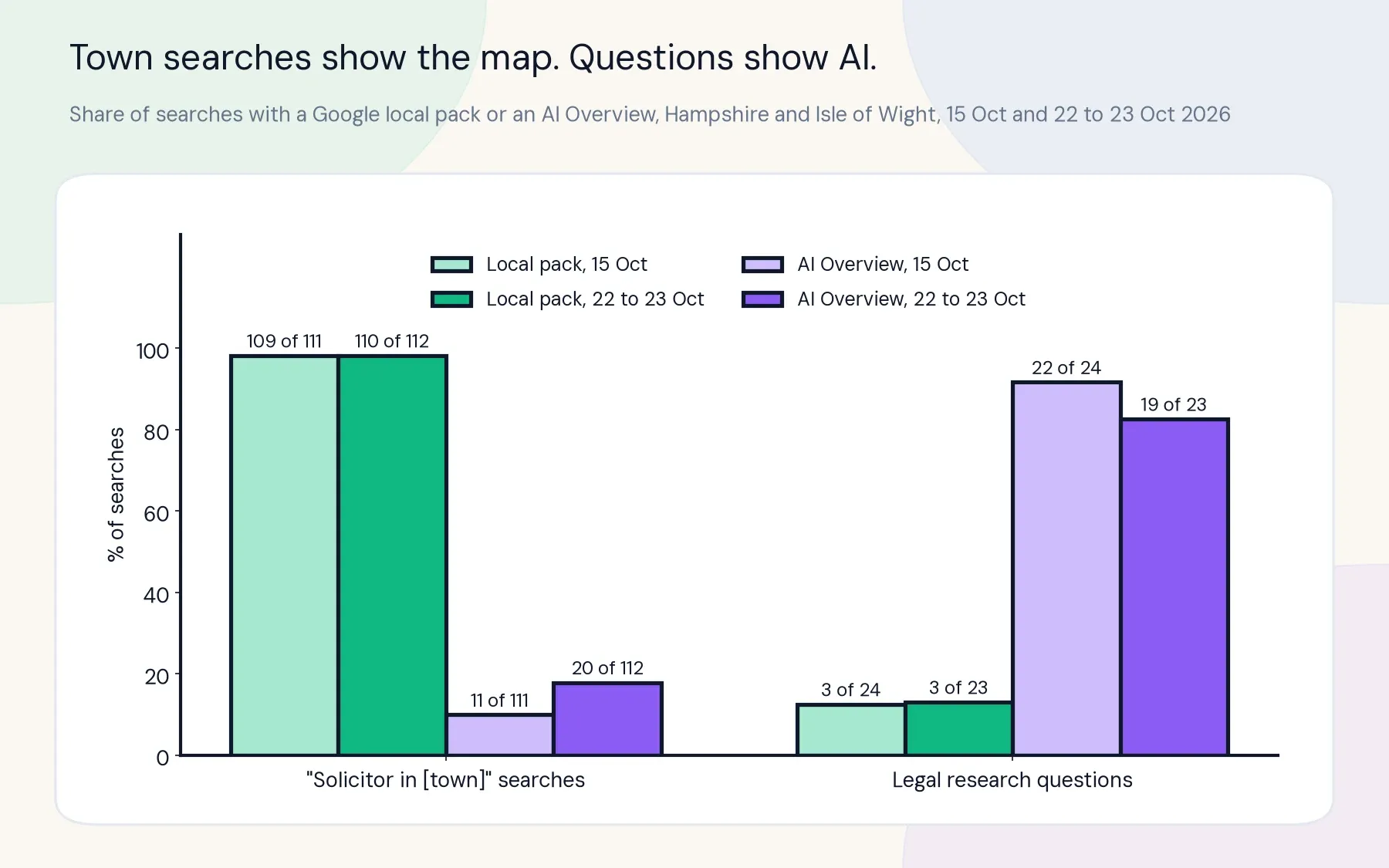
When someone searches for a solicitor in their town, Google shows a map. A local pack appeared on 110 of 112 town searches, and an AI Overview on 11 of 111 in the first collection and 20 of 112 in the second. The local pack held steady between the two collections, while town AI Overviews moved the most.
Research questions look different. An AI Overview appeared on 22 of 24 in the first collection and 19 of 23 in the second, and a local pack on 3 of 23. AI Overview results change regularly, which is why both collections are shown.
Sample firms were cited in 14 of the 39 AI Overviews seen. In the 19 research AI Overviews from the second collection, 4 cited a sample firm, and gov.uk was cited in 10 of 19. A firm that answers questions clearly on its own site gives Google something to cite.
Directories Sit Between Firms and Clients
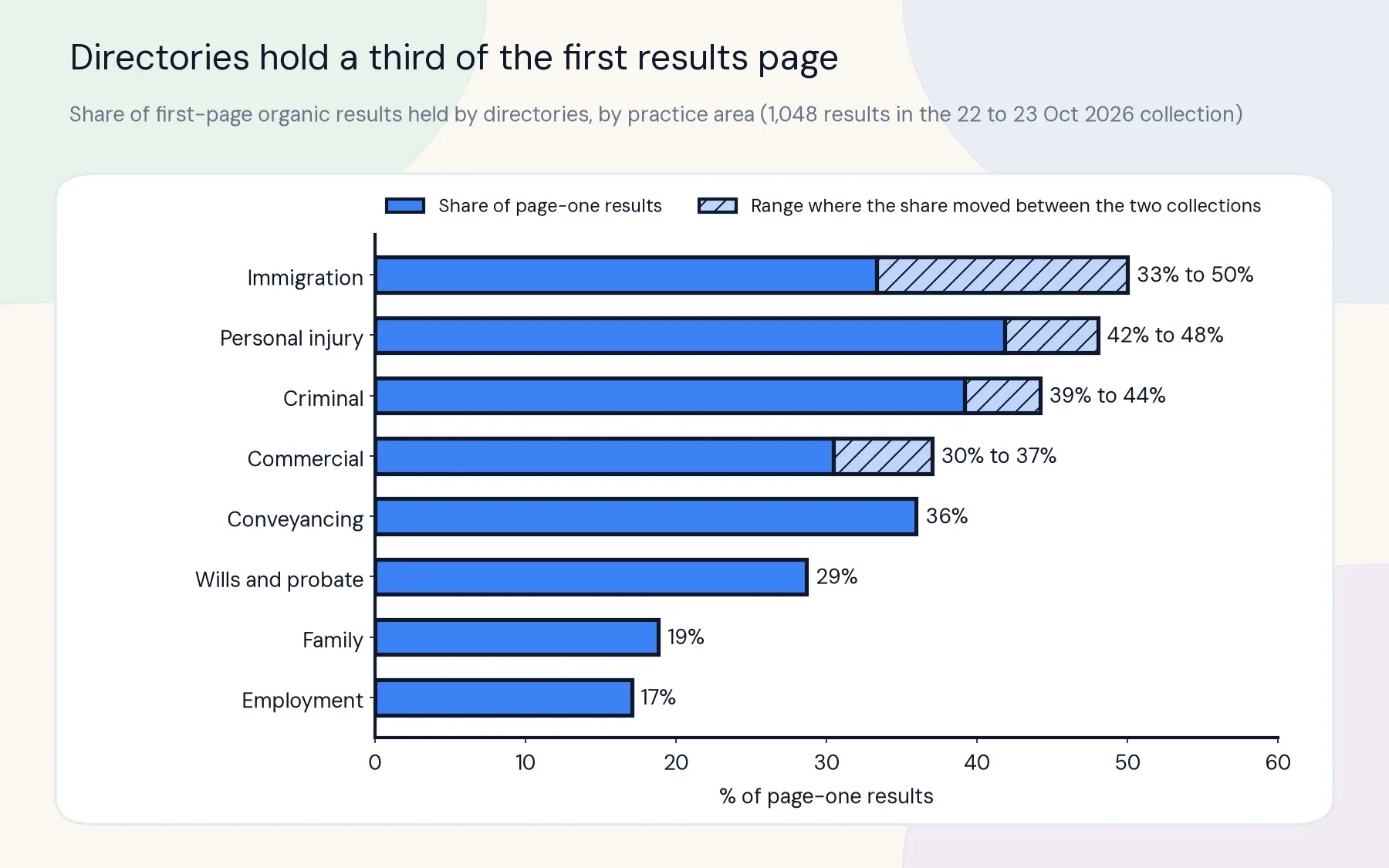
Across 1,048 first-page organic results, directories held 32%. ReviewSolicitors was on the first page for 72 of 112 town searches, and a directory was in the top 3 on 76 of 112.
The share changes by practice area, and in four areas it moved between the two collections. Directories held 33% to 50% in immigration, 42% to 48% in personal injury, 39% to 44% in criminal and 30% to 37% in commercial. They held 36% in conveyancing, 29% in wills and probate, 19% in family and 17% in employment.
The map is busy too. 115 different businesses filled 343 local pack slots, and the 6 most frequent held 21%.
How Firms Scored
Each firm was scored out of 100 across six pillars. The median was 64, and scores ran from 36 to 89.
10 firms were Leading (80 and over) and 30 were Established (60 to 79). 18 were Developing (40 to 59) and 2 were Early stage (under 40).
Scores by Size
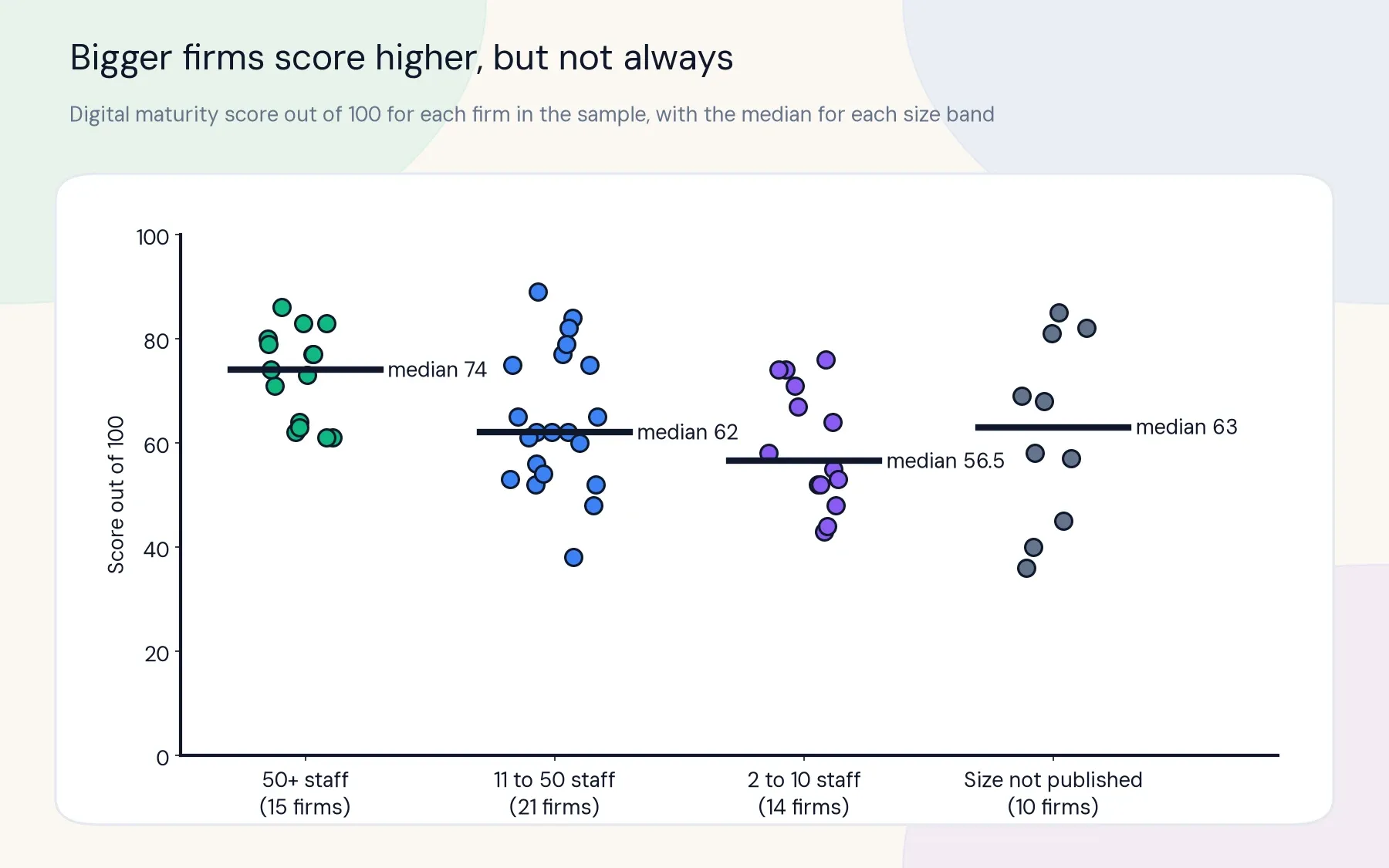
Larger firms tended to score higher. The median was 74 for firms with 50+ staff (15 firms), 62 for 11 to 50 staff (21) and 56.5 for 2 to 10 staff (14). Firms whose size is not published had a median of 63 (10).
The Six Pillars
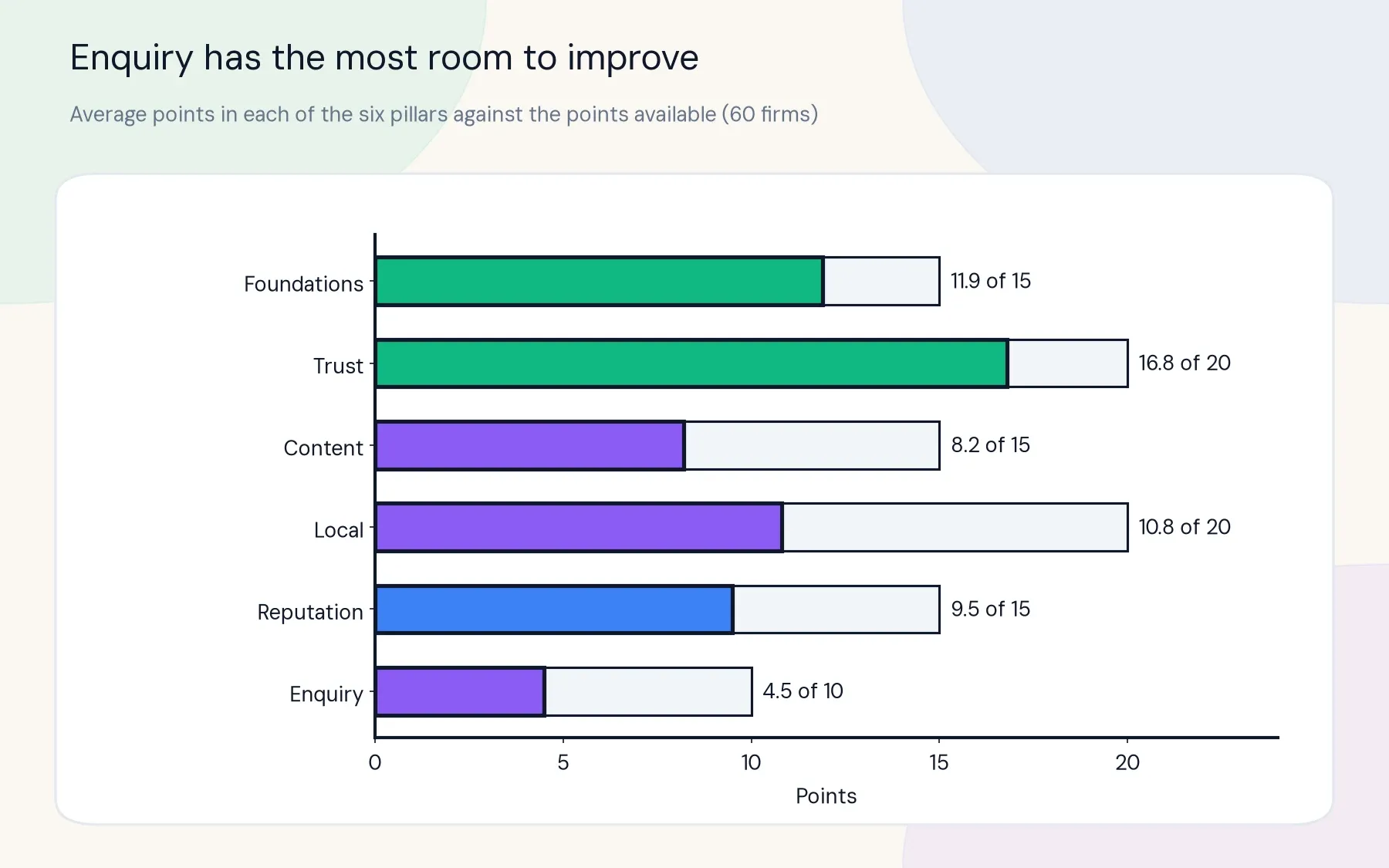
Trust and Foundations were the strongest pillars, with averages of 16.8 of 20 and 11.9 of 15. Reputation averaged 9.5 of 15 and Local 10.8 of 20.
Content averaged 8.2 of 15 and Enquiry 4.5 of 10. These are the two places most firms have the most room to improve.
Google Business Profiles
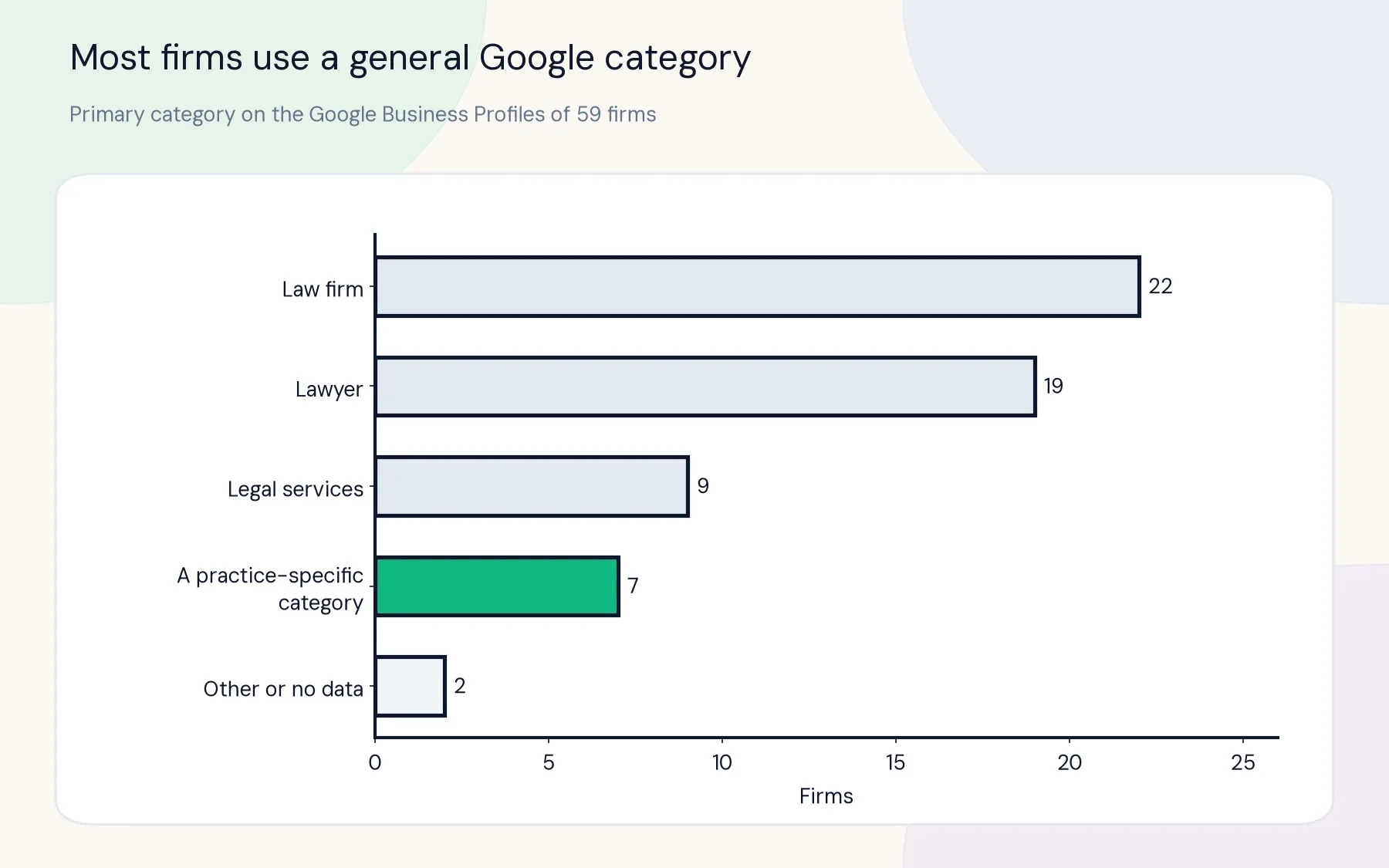
A profile was found for 59 firms. 7 of 59 use a practice-specific primary category.
The rest use "Law firm" (22), "Lawyer" (19), "Legal services" (9) or another or unknown category (2). The primary category tells Google what a firm does, so a general one says little about the work a client is searching for.
Turning Visits into Enquiries
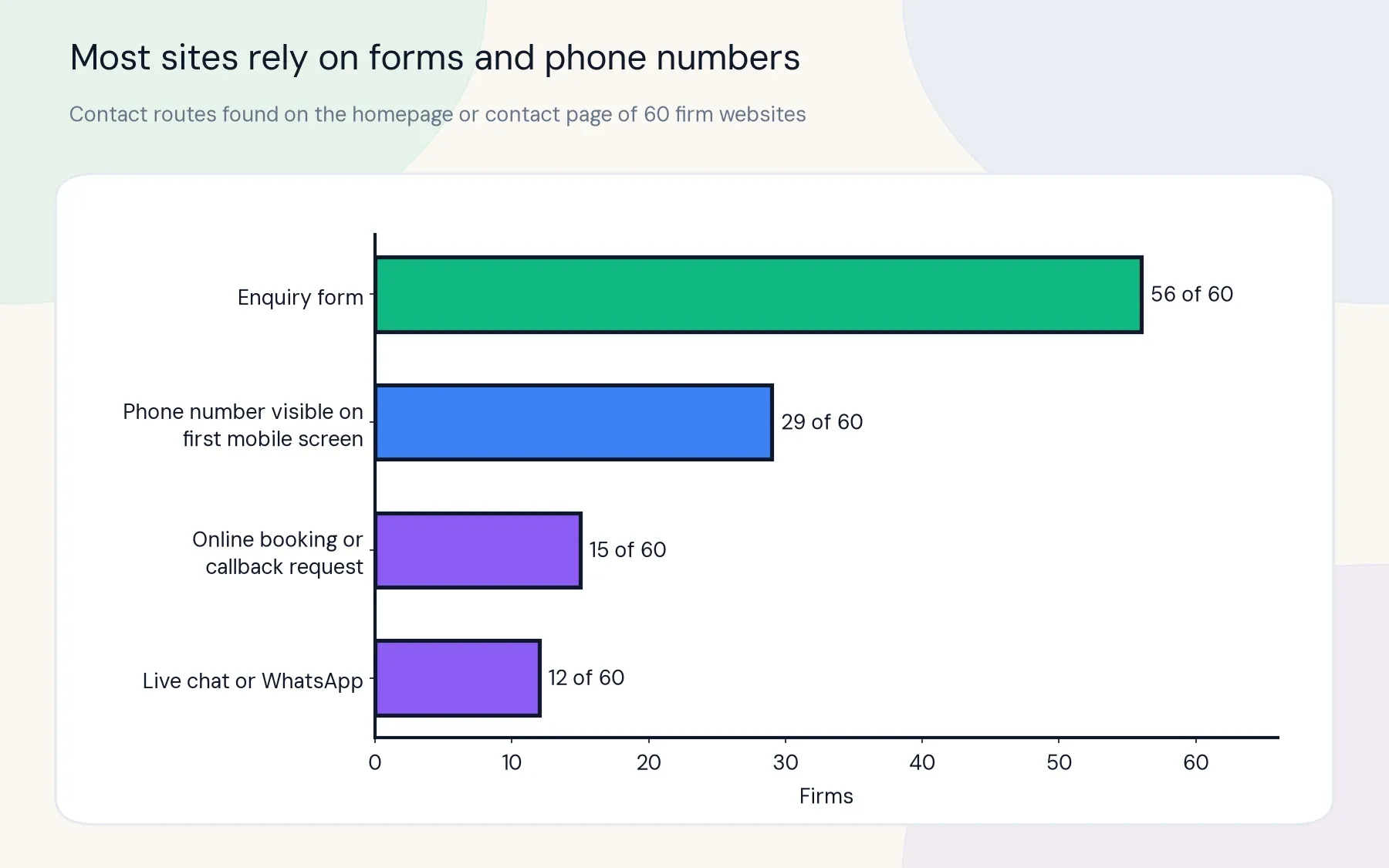
Almost every site had an enquiry form, at 56 of 60. Fewer made it easy to act straight away on a phone.
A phone number was visible on the first mobile screen for 29 of 60 websites. 15 of 60 offered online booking or a callback request, and 12 of 60 offered live chat or WhatsApp.
Reviews and Replies
Ratings were strong. 36 of 58 firms with a rating score 4.5 or more, and 21 of 59 have 100 or more Google reviews. The median was 67 reviews.
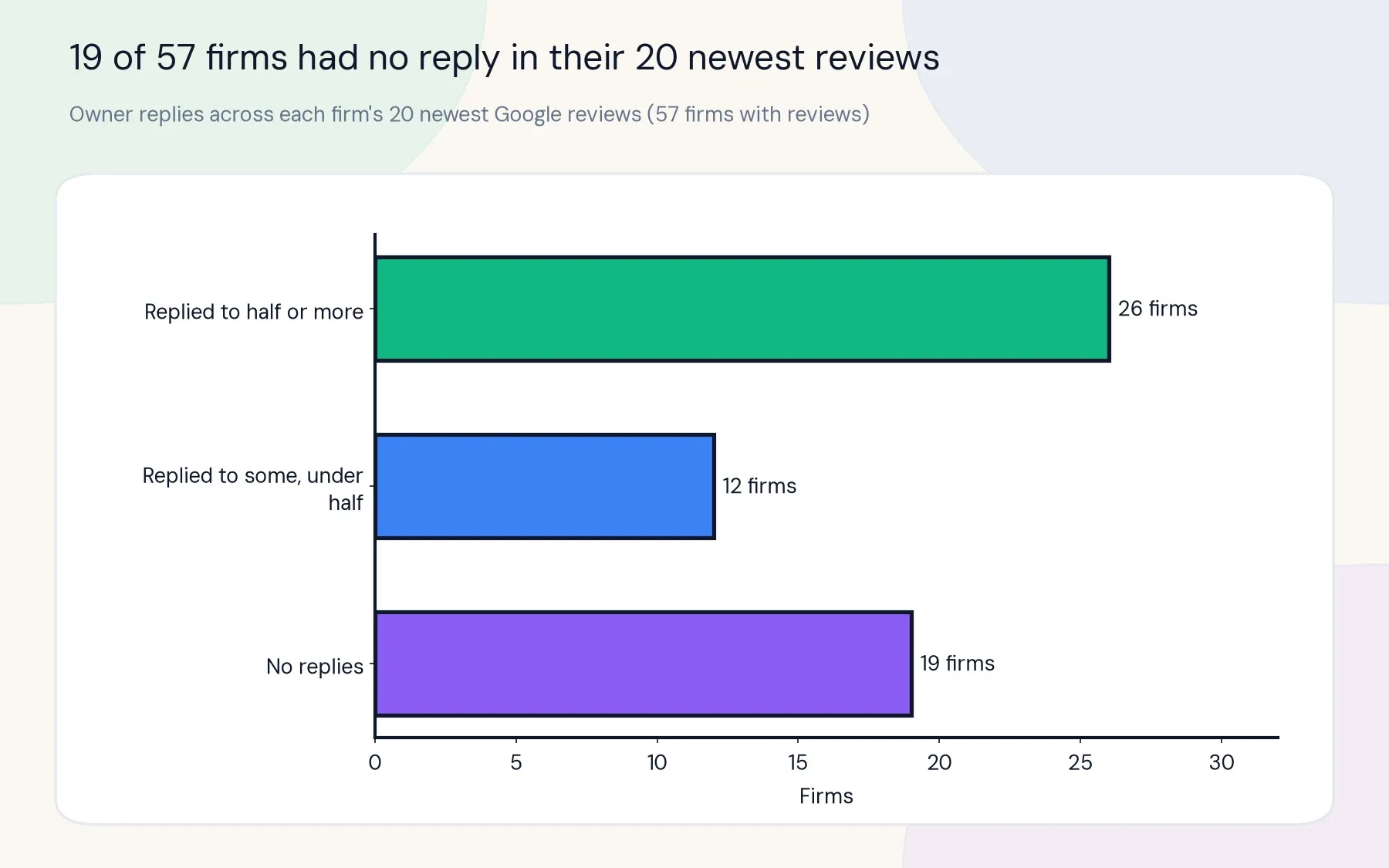
Replies were less consistent. Across the 20 newest reviews of 57 firms, 19 had no replies, 12 replied to under half and 26 replied to half or more.
Recency matters to a reader comparing firms. 14 of 57 had no new review in the last 90 days.
Prices
49 firms offer at least one service where the SRA expects published prices. 31 of 49 publish prices for every such service they offer, and 9 publish none.
Clear prices help a client compare firms before they get in touch.
What Good Looks Like
Several firms in the sample show what a clear, findable presence looks like.
Biscoes, Churchers, Dutton Gregory, Larcomes and Warner Goodman publish full pricing across their SRA price categories. Parker Bullen sets out clear published costs for probate.
Lamb Brooks has a strong all-round digital presence. Scott Bailey and Herrington Carmichael publish regular content with named authors.
Get Your Firm's Score
Every firm in the sample has a private score sheet. It shows how the firm scored in each of the six pillars, so partners can see where it is being found and where it falls short.
Ask for your firm's sheet through the contact page. For a fuller picture, request a free law firm SEO audit: a senior team member reviews your site and sends a written report and a recorded video walkthrough.
Methodology
The sample is 60 law firms with offices in Hampshire and the Isle of Wight. Firms were chosen across five reporting areas and three size bands (2 to 10, 11 to 50, 50+ staff), plus firms whose size is not published.
The same 136 searches were collected twice from Google UK results, on desktop and located to each town: 112 town searches across 8 practice areas (family, conveyancing, wills and probate, employment, personal injury, criminal, immigration, commercial) and 24 research questions. The first collection ran on 15 Oct 2026. 135 of 136 returned, because one town search (immigration, Havant) failed, leaving 111 town searches and 24 research questions.
The second collection ran on 22 Oct 2026, with failed searches retried on 23 Oct 2026. 135 of 136 returned, because one research question failed, leaving 112 town searches and 23 research questions.
Figures are from the second collection unless both are given. Where a figure moved by 5 points or more between collections, both are shown. Local pack share in the scores counts appearances across both collections.
Websites, Google Business Profiles and reviews were checked on 15 Oct 2026, with every zero and a 10% sample re-checked by hand.
Each firm has a score out of 100 across six pillars: Foundations, Trust, Content, Local, Reputation and Enquiry. Reporting areas with fewer than five firms were combined (New Forest, East Hampshire and Isle of Wight).