

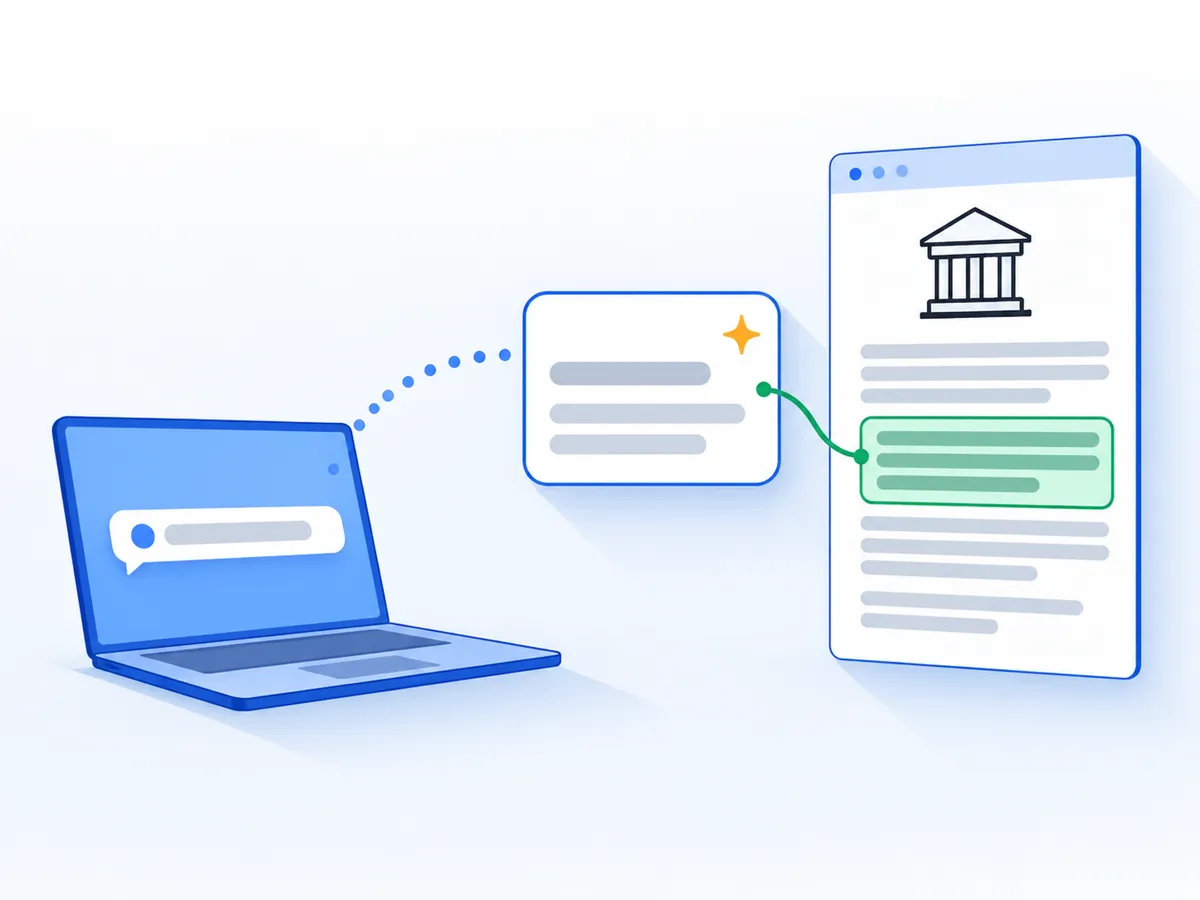
AI search for law firms is the work of making a firm's pages easy for AI answers, such as Google's AI Overviews and ChatGPT, to find, select and name. These tools pick short passages from pages they trust, then rewrite them into an answer. The firms that appear are usually the ones whose pages answer a client's question clearly, accurately and near the top.
Key takeaways
- AI tools pick passages, not pages. A clear answer in the right place matters more than length.
- SEO foundations still decide whether a firm is in the running. Google says the same SEO fundamentals apply to its AI features.
- Measure enquiries and branded demand, not AI scores. No one can report a true AI click-through rate.
This guide draws on research by Affirmed's founder, Rich Voller, on the Hampshire and Isle of Wight report and on the platforms' own documentation. Rich's findings are snapshots from mid-2026 studies, and they show the direction AI search is taking.
Contents
- Where do AI answers appear in UK legal search?
- Does every legal question go to the web?
- How does an AI choose which page to use?
- What makes a legal page passage easy to select?
- Where on the page do AI tools cite from?
- Why does authority off your own site matter?
- Can confident marketing copy hurt you in AI answers?
- Should a law firm block AI crawlers?
- Do schema and technical SEO get you into AI Overviews?
- How should a law firm measure AI search?
- Where does this fit in SEO for solicitors?
- FAQs
- Next step
Where do AI answers appear in UK legal search?
AI Overviews in UK legal search mostly appear on research questions, such as how probate works, rather than on "solicitor in [town]" searches. Town searches still lead to the map pack. In the Hampshire research, gov.uk was a frequent source on research questions.
What the Hampshire research found
The Hampshire report's search data was collected twice from Google UK results, on 15 Oct and 22 to 23 Oct 2026, covering 112 town searches and 23 research questions across 8 practice areas in the second collection. An AI Overview appeared on 22 of 24 research questions in the first collection and 19 of 23 in the second, and a local pack on 3 of 23. A local pack appeared on 110 of 112 town searches, and an AI Overview on 11 of 111 in the first collection and 20 of 112 in the second.
Sample firms were cited in 14 of the 39 AI Overviews seen. In the 19 research AI Overviews from the second collection, 4 cited a sample firm, and gov.uk was cited in 10 of 19. AI Overview results change regularly, and the two collections show it.
What this means for a firm
For town searches, the map pack and the firm's Google Business Profile carry most of the weight, as our local SEO guide for law firms explains. For research questions, the firm's own guides and practice pages are what an AI Overview can cite.

Does every legal question go to the web?
Not every legal question sends an AI tool to the web. Before answering, a model decides whether to search for sources (a grounded query) or answer from what it learned in training (an in-model query). A firm's pages can only be selected when the query is grounded.
Grounded and in-model questions
Rich Voller's post on grounding explains the split. Questions that are fresh, local, comparative or changeable, such as fees, current rules or which firms are nearby, tend to send the model to the web. Settled definitions, such as what probate means, are often answered from training data. Rich's free Grounding Query Classifier estimates whether a query is likely to be grounded or answered from model memory.
What a firm can influence
Rich sorts queries into four groups, and each calls for a different response:
- Grounded, and the firm is cited: keep the page accurate and current.
- Grounded, and the firm is not cited: the clearest opportunity. Improve the page that should answer it.
- In-model, and the firm is named: protect that reputation with consistent information across the web.
- In-model, and the firm is not named: page edits won't change this. Wider mentions, digital PR and coverage are the levers.
How does an AI choose which page to use?
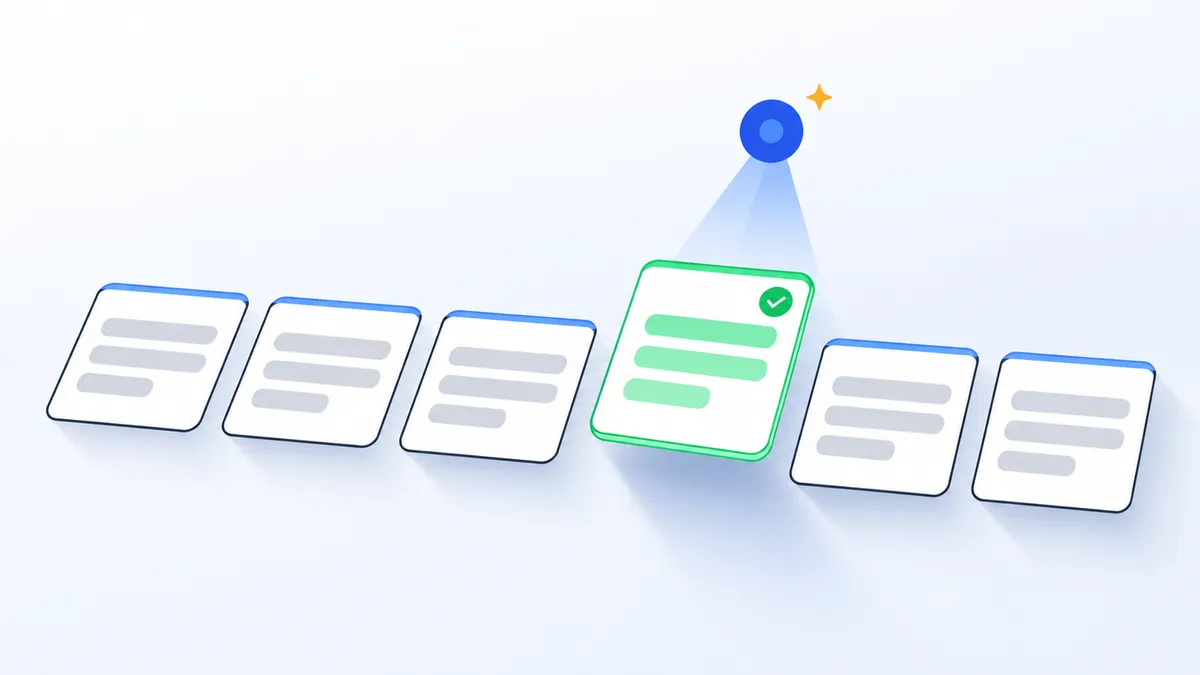
An AI search tool chooses a page in stages. It retrieves candidate pages, runs extra sub-queries, shortlists sources, selects passages and writes its own answer. Because the visible answer is rewritten, the goal is to be the passage selected as a source, not to be quoted word for word.
The pipeline in plain terms
Rich Voller's Selection Rate Optimisation post, which credits the idea to Dan Petrovic of DEJAN, sets out the stages: retrieval, fan-out, grounding, selection and synthesis. His summary is that "Traditional SEO is still the price of admission."
Fan-out sub-queries
Fan-out is the set of hidden sub-queries an AI runs to build a full answer. Rich's fan-out post notes that People Also Ask is not the same thing: PAA reflects search popularity, while fan-out reflects the model's reasoning.
In the AirOps and Kevin Indig research reported in that post, pages covering 26 to 50% of fan-out sub-queries outperformed pages covering all of them. Rich's free Query Fan-Out Gap Analyser groups fan-out queries by intent and scores them against a URL.
What makes a legal page passage easy to select?
A legal page passage is easier to select when it names its subject, answers the question in the first sentence and uses the client's own words. In Rich Voller's study of the retrieval gate, these traits separated selected passages from the rest. On legal topics, authority and specifics mattered more than speed.
What the study found
Rich Voller's retrieval-gate study covered 30 queries and 385 candidates, cross-judged between Gemini and ChatGPT. The traits that mattered most were:
- Naming the subject in the first sentence: a 4.2x lift on Gemini and 2.7x on ChatGPT.
- Answering first: a 3.3x lift on Gemini.
- The client's own words: query-language match gave a 4.2x lift on Gemini.
- A factual anchor: a date, a named source or a specific figure.
- Authority on legal (YMYL) topics: factual claims appeared in 71% of the passages Gemini selected, against 57% for answer-first. In Rich's words, "authority beats speed".
Passage length as a guide
Selected passages fell in ranges rather than at fixed lengths. Gemini grounding chunks had a median of 126 words and ChatGPT cited claims a median of 53 words, while Gemini's selected passages on YMYL topics were about 155 words.
Clear writing, not AI rewriting
This is the clear, people-first writing Google already asks for. Google's guide to optimising for generative AI features, published in May 2026, says there is no need to rewrite content just for AI systems or to break it into chunks.
For a law firm, that means fee-earner-reviewed pages in plain English, with each answer standing on its own. Our content strategy service plans and writes this kind of page. Rich's free SRO Snippet Tester compares a snippet with competing snippets for a grounded query.
Where on the page do AI tools cite from?
AI tools cite most often from the top of a page and from lists. In Rich Voller's long-form study, the top third of pages drew more citations than its share of the content, and answers buried mid-page were often cited inaccurately.
What the long-form study found
Rich's study of what AI cites from long-form pages covered 15 pages, 120 queries and 480 calls across four platforms. The top third held 37% of content and drew 47% of citations. Bullet lists were under 7% of content and drew nearly 19% of citations.
Mid-page answers were cited correctly 45% of the time. Rich's conclusion was that "Structure beat length every time."
Practical rules for legal pages
- The core answer and a plain definition near the top.
- Key points summarised in a short list.
- Question headings that match how clients ask.
- The most important point kept out of the middle of a long section.
Why does authority off your own site matter?
Authority off a firm's own site matters because AI tools often cite third-party pages over the firm's own. In Rich Voller's long-form study, established third-party pages were cited about three times as often as the author's own pages.
Third-party pages and directories
In that study, third-party pages were cited 14.4% of the time, against 4.4% for the author's own. The Hampshire report found the same pattern in ordinary search, where directories held 32% of first-page organic results.
Earned mentions
A firm builds this authority through accurate legal directory entries, local press coverage and genuine mentions in relevant publications. Our link building and digital PR service covers this work. A consistent profile matters too, as our Google Business Profile guide for solicitors explains.
Can confident marketing copy hurt you in AI answers?
Confident marketing copy can hurt a law firm in some AI answers. In Rich Voller's replication of a 2026 study, the same promotional page helped a brand in ChatGPT and harmed it in Claude, so copy built on superlatives and instructions carries a real risk.
What the replication found
Rich's replication ran 540 trials based on the arXiv:2606.09204 paper. In the earbuds niche, Claude Opus went from 100% to 7% and GPT from 27% to 100% on the same document.
The effect was strongest in competitive categories. The paper is a workshop preprint, so Rich treats this as a clear direction for writing brand pages.
Plain claims over hype
The risky patterns are superlatives such as "leading" or "number one", stacked commands and claims with no evidence. Stray HTML comments or code-like notes left in a page carry the same risk.
Checkable facts work better: accreditations, the firm's SRA number, named solicitors and their experience, and dates. These also suit how a regulated firm describes itself.
Should a law firm block AI crawlers?
Blocking AI crawlers is a choice each law firm makes for itself, and search crawlers and training crawlers are separate decisions. For a firm that wants to be found and named in AI answers, Rich Voller's research points towards allowing search crawlers.
Search crawlers and training crawlers
OpenAI's overview of its crawlers lists OAI-SearchBot, used for ChatGPT's search features, and GPTBot, used for training, as independent robots.txt settings. A firm can allow one and block the other. Rich's grounding research shows that in-model answers only change through presence in training data and wider mentions, so blocking training crawlers removes one route to being known.
Google's controls
Google's AI features page says robots.txt rules for Googlebot control crawling for Search, and that nosnippet and max-snippet controls limit what is shown. Search Console also has a Search generative AI control that excludes a site from AI Overviews and AI Mode.
Google says that control isn't used as a ranking signal for other parts of Search. A site that opts out also receives no traffic or impressions from those features, so the trade-off is visibility in AI answers against control over use.
Affirmed's own robots.txt explicitly allows AI search crawlers, such as OAI-SearchBot, and AI training crawlers, such as GPTBot, and disallows its /api/ form endpoints. That is Affirmed's approach, and each firm makes its own choice.

Do schema and technical SEO get you into AI Overviews?
Schema and technical SEO make a law firm's pages eligible, but neither is a special route into AI Overviews. Google says there are no additional requirements and no special schema for its AI features. A page must be indexed and eligible to show with a snippet.
What Google says
Google's AI features page says SEO fundamentals remain relevant for AI Overviews and AI Mode. Its May 2026 guide adds that Google Search ignores llms.txt files and doesn't need content chunking.
Why schema and technical health still matter
Schema still describes the firm, its offices and its people accurately, and Google's guide recommends keeping structured data as part of wider SEO. Our schema and structured data service handles this for law firms. Our technical SEO service covers indexing, snippet eligibility, speed and clean HTML with no stray comments.
How should a law firm measure AI search?
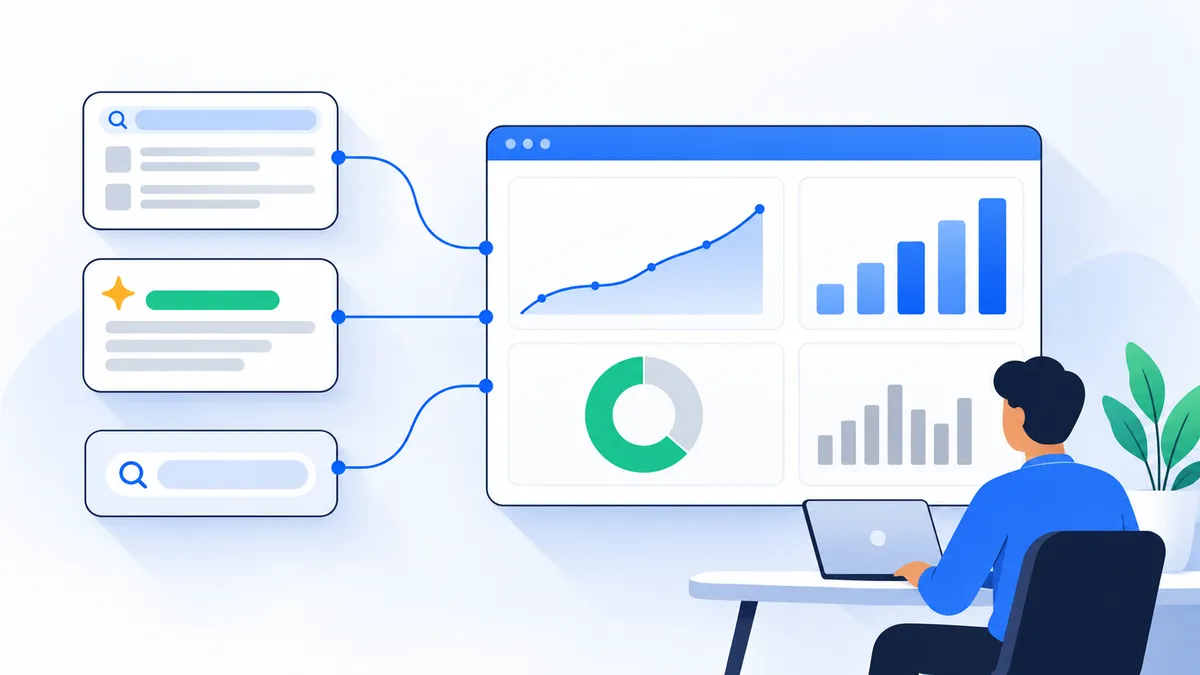
A law firm should measure AI search through enquiries, branded search and Search Console trends, not AI scores. No one can report a true AI click-through rate, because the data needed for it isn't published. The clearest view comes from several sources read together and tied back to enquiries.
What the tools show
Google says AI feature traffic is counted in Search Console's Performance report, within the "Web" search type. Its Generative AI performance report shows impressions in AI Overviews and AI Mode.
Rich Voller's post on the Google traffic data notes that the report has no clicks, so no one can report AI CTR. GA4's AI Assistant channel, live since 13 May 2026, counts as a floor rather than a ceiling, because some AI visits arrive without a referrer and land in Direct.
Branded search carries AI influence
The same post reports Similarweb data showing that 55.9% of traffic after a ChatGPT brand recommendation arrived via branded search. Influence from AI answers often shows up later, when people search for the firm by name.
What to watch
- Branded search volume over time.
- Enquiries by practice area.
- Queries in Search Console where impressions rose while clicks fell.
- Citation checks on grounded queries, rather than paid "AI visibility scores" built on fixed prompts.
- Bing Webmaster Tools AI Performance and Microsoft Clarity AI Citations, which cover Microsoft's surfaces only.
Our analytics and reporting service sets up this tracking. A free law firm SEO audit is a simple way to see how the site is set up today.
Where does this fit in SEO for solicitors?
AI search sits inside SEO for solicitors as one part of it, not beside it. The same foundations of trusted, accurate pages, technical health and local presence decide whether AI tools can find and select a firm. Passage-level writing is the added layer.
Our guide to SEO for solicitors covers those foundations, and the Hampshire and Isle of Wight report shows where firms stand. AI search work is part of our law firm SEO work, scoped for each firm.
FAQs
Do we need a separate GEO or AI SEO strategy?
A law firm doesn't need a separate GEO strategy, because GEO, or generative engine optimisation, uses the same foundations as SEO: indexed, trusted, accurate pages. Google's May 2026 guide describes optimising for generative AI search as still SEO. The added layer is passage-level writing, with clear answers near the top of each section.
Can we pay to appear in AI Overviews?
Google's documentation describes no paid route into AI Overviews for organic answers. Its AI features page says there are no additional requirements beyond being indexed and eligible to show with a snippet. Schemes that sell AI citations or inauthentic mentions are worth avoiding, and Google's May 2026 guide says inauthentic mentions are not as helpful as they might seem.
Should we block AI crawlers?
Blocking AI crawlers is the firm's own decision, and search crawlers and training crawlers are separate choices. OpenAI lists OAI-SearchBot for search and GPTBot for training as independent settings, so a firm that wants to appear in ChatGPT search can allow OAI-SearchBot whatever it decides about GPTBot. Google's Search generative AI control in Search Console is a separate setting for AI Overviews and AI Mode.
Does schema get us into AI Overviews?
Schema doesn't get a page into AI Overviews on its own, and Google says no special schema is needed for its AI features. Schema still helps Google understand the firm, its offices and its solicitors accurately, and Google recommends keeping it as part of wider SEO. Eligibility depends on the page being indexed and able to show with a snippet.
Can anyone report our AI click-through rate?
No one can report a true AI click-through rate for a law firm. Search Console's Generative AI performance report shows impressions, not clicks, so AI CTR can't be calculated from it. A firm can watch branded search, enquiries by practice area, Search Console trends where impressions rise as clicks fall, and GA4's AI Assistant channel as a minimum count.
Can we use AI to write our legal pages?
AI can help draft legal pages, but every page needs review by a fee-earner and accurate evidence before it goes live. Accuracy matters more when an AI answer may quote a passage. Rich Voller's research also found that hype-heavy copy, full of superlatives and instructions, can count against a brand in some AI tools.
More answers on our law firm SEO FAQs page.
Next step
A free law firm SEO audit is a practical place to start. Affirmed's free law firm SEO audit is a written report and a recorded video walkthrough, delivered in 3 to 5 business days, and there are no contract tie-ins.
The audit includes an AI search check. It checks whether the site is set up as well as possible for LLMs, including not blocking AI bots. Firms in the Hampshire and Isle of Wight sample can also ask for their private score sheet through the Hampshire report.