

Local SEO for law firms is the work of being found and chosen when people nearby need a solicitor. It covers three places: the Google map pack, the local organic results and the AI answers that now sit above them. Done well, it puts each office and practice area in front of the people searching in that town.
This guide draws on Affirmed's own research, the Hampshire and Isle of Wight Legal Digital Maturity Report. It looked at 60 law firms with offices in Hampshire and the Isle of Wight, using search data collected on 15 Oct and 22 to 23 Oct 2026 from Google UK.
What the research covered
The report collected the same searches twice. The second collection covers 112 town searches across 8 practice areas, plus 23 research questions. Each section below starts from what those searches showed, then sets out what a firm can do about it.
The figures describe the firms in the sample. They show where local search is crowded, where firms fall short and where the easiest gains sit.
Contents
- Local search has split in two
- Google Business Profile: the foundations
- Directories: competitors and citations
- A crowded map
- Reviews: ratings, replies and recency
- Local pages that earn the click
- Turning local visits into enquiries
- Prices and trust
- More than one office
- Local schema in brief
- Measuring local SEO
- FAQs
- Next step
Local search has split in two
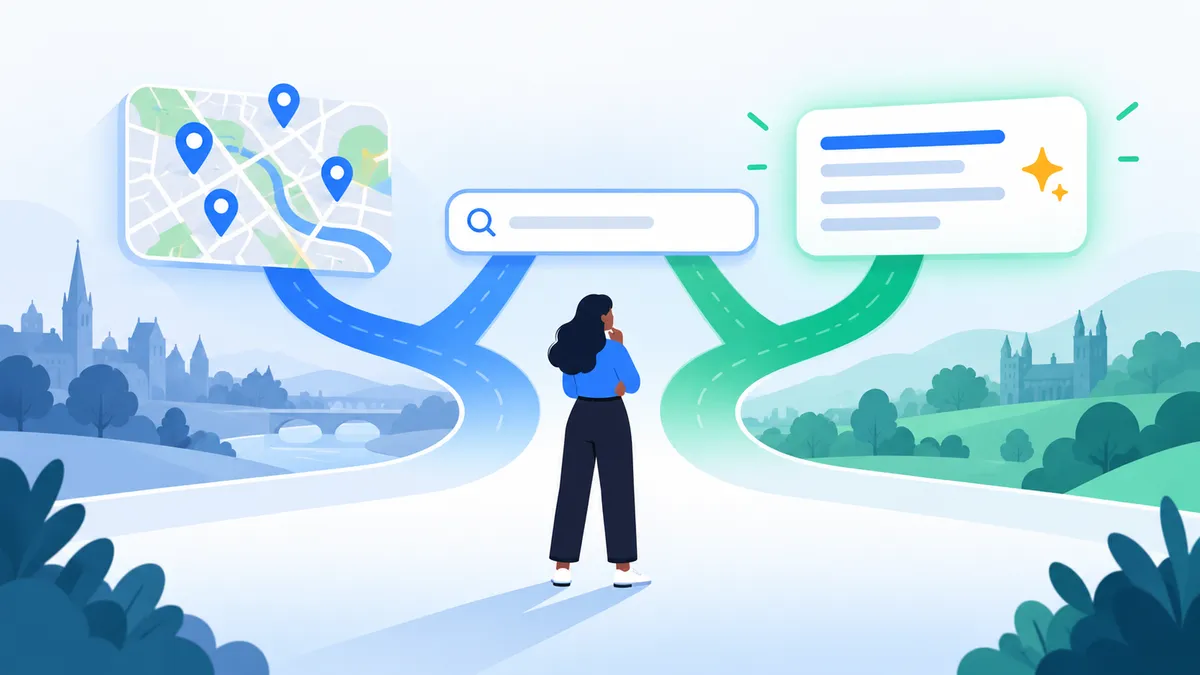
People search for a solicitor in two different ways, and Google answers them in two different places. The Hampshire research shows the split clearly.
Town searches go to the map
When someone searches for a solicitor in their town, Google shows a map. In the report, a local pack appeared on 110 of 112 town searches, and an AI Overview on 11 of 111 in the first collection and 20 of 112 in the second.
These are people ready to act. They compare a handful of firms on the map, check reviews and call or click through.
Research questions go to AI Overviews
Questions such as how probate works or what happens in a divorce look different. On research questions, an AI Overview appeared on 22 of 24 in the first collection and 19 of 23 in the second, and a local pack on 3 of 23. AI Overview results change regularly, which is why both collections are shown.
In the 19 research AI Overviews from the second collection, 4 cited a sample firm and gov.uk was cited in 10 of 19. Local firms can be named in these answers when their pages explain a topic clearly.
What this means for your pages and profiles
For town searches, your Google Business Profile, reviews and location pages do most of the work. For research questions, clear practice-area guides on your own site are what get cited.
A firm needs both. The profile earns attention at the point of choice, and the guides build trust earlier in the journey. Our local SEO service works on both sides of that split.
Google Business Profile: the foundations
Your Google Business Profile is the listing that appears in the map pack. It is often the first thing a local client sees, before your website.
Primary category
The primary category tells Google what a firm does. In the report, a profile was found for 59 firms, and 7 of 59 use a practice-specific primary category.
The rest use "Law firm" (22), "Lawyer" (19), "Legal services" (9) or another or unknown category (2). A general category says little about the work a client is searching for, so choose the UK category that best matches your main practice area.
Secondary categories and services
Add secondary categories for your other main practice areas. Then list your services with short, plain descriptions that match the practice-area pages on your site.
Hours, photos and details
Keep opening hours, phone numbers and the website link accurate. Add real photos of the office, the entrance and the team, so clients know what to expect when they arrive.
One profile per real office
Each staffed office should have its own profile, at its real address. A profile for an address where no one from the firm works does not reflect a real office and does not help clients.
Updates and suggested edits
Post occasional updates about services, office news or new guides, so the profile looks active. Check the profile regularly for suggested edits from the public, and correct anything that is wrong.
Our page on Google Business Profile optimisation covers categories, services, posts and the rest of the detail.
Directories: competitors and citations
Legal directories play two roles in local search. They are citations that confirm your details, and they are also competitors for the same first-page results.
How much of the first page directories hold
In the report, across 1,048 first-page organic results, directories held 32%. ReviewSolicitors was on the first page for 72 of 112 town searches, and a directory was in the top 3 on 76 of 112.
That means a client searching for a solicitor in their town will often meet a directory before they meet a firm's own website.
How it varies by practice area
The share changes by practice area, and in four areas it moved between the two collections. Directories held 33% to 50% in immigration, 42% to 48% in personal injury, 39% to 44% in criminal and 30% to 37% in commercial. They held 36% in conveyancing, 29% in wills and probate, 19% in family and 17% in employment.
Firms in the areas with the highest directory share have the most to gain from strong listings, because that is where clients are looking.

Make your listings complete and accurate
Check the directories that rank for your town and practice areas, such as the Law Society's Find a Solicitor and ReviewSolicitors. Make sure each listing has the right name, address, phone number, practice areas and website link.
Consistent details across every listing help search engines confirm which firm is which. Complete listings also give clients a good first impression where they meet you.
Build pages that can compete with directories
Directories rank because they cover a town and a practice area in one place. A firm can compete with a page that does the same job better: a specific page for that practice area in that town, with real local detail and a clear way to get in touch.
A crowded map
The map pack shows only a few firms at a time, and many businesses compete for those places. The Hampshire research shows how busy it is.
Many businesses share the map
In the report, 115 different businesses filled 343 local pack slots, and the 6 most frequent held 21%. The map is shared widely rather than held by a few firms. That leaves room for a firm that puts in steady work on its profile, reviews and pages.
Relevance, proximity and prominence
Google weighs three broad things when it builds a local pack. Relevance is how well a profile matches the search, which is where categories, services and practice-area pages matter.
Proximity is how close the office is to the searcher or the place named in the search. It is set by where your offices are, so the work is to make each real office as strong as possible.
Prominence is how well known and trusted the firm is, shown through reviews, links, directory listings and mentions across the web. It is built over time and is the area where most firms can make the most progress.
Ads in the pack
Some local pack places are paid ads, shown alongside the standard listings. A firm can choose to run them, but the standard listings still depend on a strong profile, good reviews and relevant pages.
Treat ads and local SEO as separate decisions. Local SEO builds the standard listing, which shows whether or not ads run.
Reviews: ratings, replies and recency
Reviews shape both where a firm appears and whether a client chooses it. The report looked at ratings, review counts, replies and how recent the reviews were.
Ratings and counts
In the report, 36 of 58 firms with a rating score 4.5 or more, and 21 of 59 have 100 or more Google reviews. The median was 67 reviews.
Strong ratings are common, so they are not enough on their own to stand out. Replies and recency are where firms differ most.
Replies
Across the 20 newest reviews of 57 firms, 19 had no replies, 12 replied to under half and 26 replied to half or more. Replying shows clients that the firm is listening, and it gives searchers a sense of how the firm treats people.
Reply to good and bad reviews in a calm, professional tone. Thank the reviewer, address the point raised in general terms and keep client details private.

Recency
14 of 57 had no new review in the last 90 days. Recent reviews tell a client the firm is active and that its service is current.
Ask for reviews at a natural point, such as when a matter closes and the client is pleased with the outcome. A short message with a direct link makes it easy.
Negative reviews
A critical review is a chance to show how the firm responds. A short, calm reply that invites the reviewer to get in touch directly reads well to anyone comparing firms.
Keep replies general, never confirm that the reviewer is a client, and never share details of their matter.
Local pages that earn the click
A good local page answers the question a client has when they search for a solicitor in a town. It should feel written for that place, not copied from another.
What a strong local page includes
- The office: its address, how to get there, parking and access.
- The practice areas: the services offered from that office, linked to the full practice-area pages.
- Local detail: the courts or registries the team works with, where relevant to the practice area.
- The team: the solicitors based there, with links to their bios.
- A clear next step: a phone number and an enquiry route near the top.
Avoid doorway pages
Pages that swap one town name for another, with no real office or local detail, help no one. Build pages for the places you serve from real offices, and make each one useful.
Our local SEO for solicitors work starts with these pages and the profiles that point to them.
Link local pages together
Each location page should link to the practice-area pages offered from that office, and each practice-area page should link back to the offices that offer it. This helps clients find the right office and helps search engines understand how the site fits together.
How markets differ
Different towns and cities behave differently in search, and the approach should follow the market. Affirmed's locations pages show how we look at markets such as Hampshire, Southampton, Portsmouth, London and Manchester.
Turning local visits into enquiries
Being found is only half the job. A local visitor on a phone needs to be able to act straight away.
The phone on the first screen
In the report, a phone number was visible on the first mobile screen for 29 of 60 websites. A client searching in a hurry should see how to call without scrolling.
Put a tap-to-call number at the top of every key page on mobile. Make sure it matches the number on your Google Business Profile.
Callback, booking and forms
56 of 60 sites had an enquiry form. 15 of 60 offered online booking or a callback request, and 12 of 60 offered live chat or WhatsApp.
Forms suit people who want to explain their situation. A callback request or booking option suits people who want to talk at a time that works for them, so offering both gives clients a choice.
Match the route to the search
Someone searching for an urgent criminal solicitor needs a phone number at once. Someone researching a will may prefer a form or a booked call at a time that suits them, so the enquiry route on each page should fit the work it covers.
The weakest pillar
Enquiry was the weakest pillar in the report, at an average of 4.5 of 10. For many firms, this is the quickest place to improve, because the changes sit on the firm's own website. A free law firm SEO audit checks these enquiry routes on your own site.

Prices and trust
Clients compare firms before they get in touch, and price is part of that comparison. The report looked at how firms publish prices for the services where the SRA expects published prices.
What the research found
49 firms offer at least one service where the SRA expects published prices. 31 of 49 publish prices for every such service, and 9 publish none.
Make prices easy to find
From a local search point of view, a clear price page answers a question many clients ask. Link it from the relevant practice-area and location pages, so a visitor can reach it in one click.
Keep the information plain and easy to read on a phone. It helps a client decide to make contact.
For trust signals more generally, such as solicitor bios and the SRA digital badge, see our guide to SEO for solicitors.
More than one office
Multi-office firms face the same local questions for each office. Each one needs its own presence.
One profile and one page per office
Give each staffed office its own Google Business Profile and its own location page on the website. Link each profile to its matching page rather than the homepage.
Consistent details
Use the same firm name and the same format for each office's address and phone number everywhere. Directory listings should match the profile and the page for that office.
No virtual offices
Avoid profiles at virtual offices or addresses where no one from the firm works. Focus instead on making each real office strong in its own area.
Our guide to SEO for multi-location law firms covers office structure, profiles and pages in more detail.
Local schema in brief
Schema is structured data that describes the firm to search engines in a precise way. For local search, it confirms each office's details.
What to mark up
Use LegalService or Organization markup for the firm, with each office's name, address, phone number and opening hours. Link each office to its location page.
What to leave out
Leave out review star markup for your own reviews on your own site, because Google does not show stars for a business's reviews of itself. Our schema and structured data service covers this markup across a law firm site.
Measuring local SEO
Local SEO is worth measuring by what clients do, not only by where a firm appears. The useful questions are which offices and practice areas bring enquiries, and how.
What to track
- Calls: from the website and from each Google Business Profile.
- Direction requests: from each profile, a useful sign of local intent.
- Forms: enquiry form submissions, tracked by office and practice area.
- Searches and pages: the local searches and landing pages behind those enquiries.
Reporting that leads to action
Review these figures by office and practice area each month. The pattern shows which offices need more work and which pages are already doing well.
Add your own enquiry records
Website data shows calls and forms, not what happens after them. Adding the firm's own records of which enquiries were a good fit shows which offices and pages bring the right work.
Our analytics and reporting service sets up this tracking and monthly reporting for law firms.
FAQs
How much does local SEO cost for a law firm?
The cost comes from the work a firm needs. The main factors are how competitive its practice areas are, how many offices and towns it covers, the state of its profiles and site, and how many local pages need writing. Our pricing page explains how Affirmed shapes the work around these.
Can I do local SEO myself?
Yes, much of the groundwork is within reach of a firm. Choosing the right primary category, keeping details consistent, asking for reviews and replying to them are all things a practice manager can own. Specialist help is most useful for local pages, schema, tracking and multi-office structure.
How long does local SEO take?
It comes down to the market and the starting point. A firm in a quiet town with a sound profile can move faster than one in a busy city with new offices, thin pages or inconsistent listings. Fixing the basics first gives every later step a stronger base.
Do I need a Google Business Profile for each office?
Yes, for each staffed office. Each profile should sit at the office's real address, list the practice areas offered there and link to that office's location page on your website.
Do legal directories still matter?
Yes. Directories confirm a firm's details and they appear in the search results themselves, often near the top. Complete, accurate listings on the directories that rank for your town and practice areas put the firm in front of clients where they are already looking.
Can we appear in the map pack for a town where we have no office?
The map pack leans heavily on proximity, so it favours firms with an office in or near the town searched. For towns you serve without an office, focus on helpful practice-area content and strong directory listings, and build a local presence where you have a real office.
More answers on our law firm SEO FAQs page.
Next step
The quickest way to see how your firm shows up locally is an audit of your own site and profiles. Affirmed's free law firm SEO audit is a written report and a recorded video walkthrough, delivered in 3 to 5 business days.
There are no contract tie-ins if you decide to go further. You can also see the full Hampshire and Isle of Wight report and ask for your firm's private score sheet.